
Q+A from Recent Studio Visits
Questions I’ve received in the studio, and my answers to them

I was reminded of this newsletter, abandoned in the drafts, as I read Jodi Hays’ recent newsletter, What’s Up with All The White Trucks. (You’ll notice a trend of re-worked drafts as I restart ARTWORDS after some time away.) Take note of the last question, one that I’m sure all artists have heard and have their own way of navigating—whether or not they share the “value-determining hours tally” of the physical making that goes into the work or something more poetic.
During the summer of 2023 I hosted several studio visits, taking notes of the common questions that those viewing my work were asking (with the thought of answering them here). Answers follow.
Where do you source your materials?
Do you hold on to any found objects or images as special? And how might a special object make its way into your work?
Do you ever use your own materials?
Why are all the quilts on backwards?
Are the words or objects themselves important or do you think of them as elements like color, just part of the main work?
Do you do ever work with someone’s sentimental family stuff to make a commission?
How long do they take you?
Where do you source your materials?
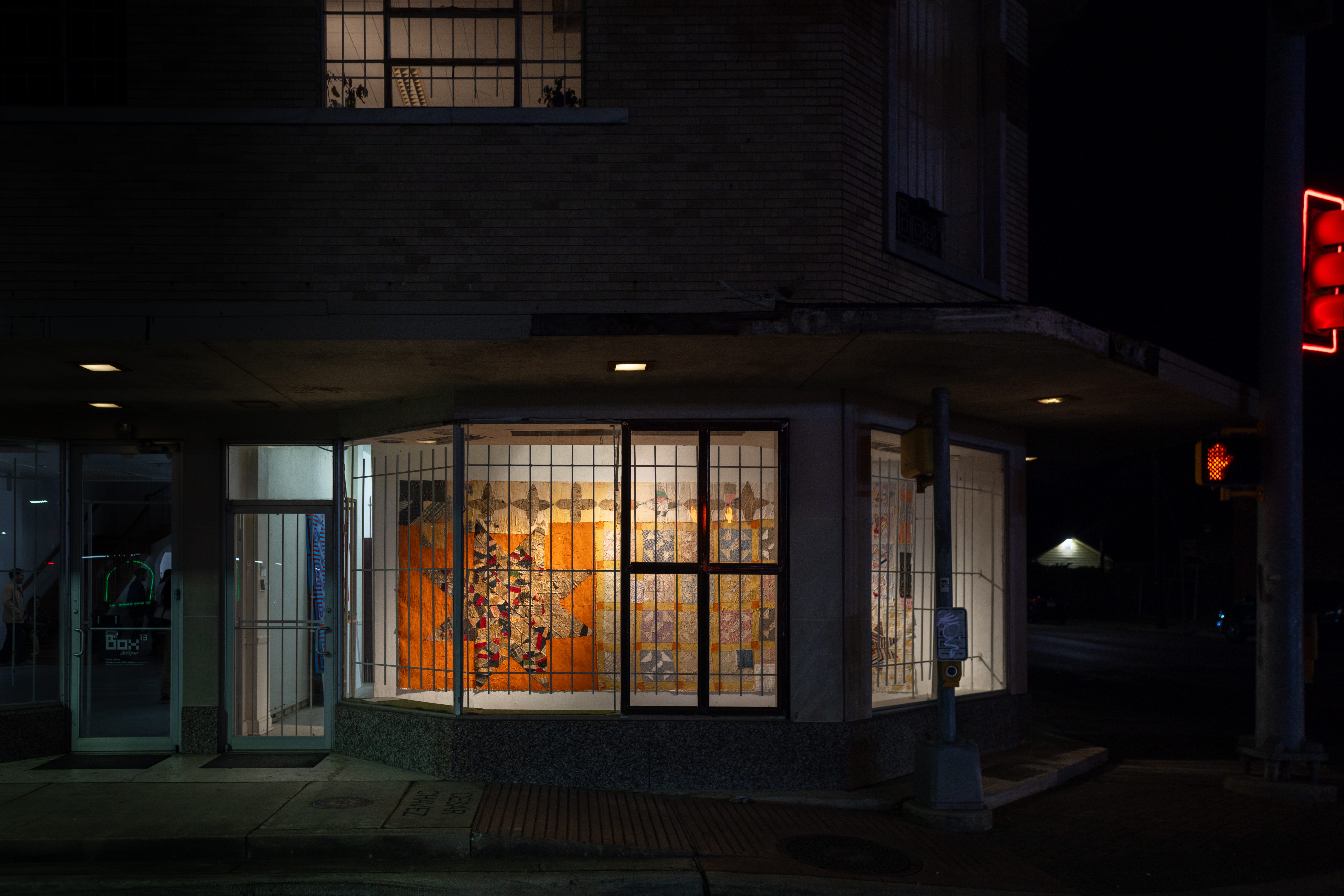
At this point, most of the found objects are gifts to the studio. I began by purchasing ephemera at thrift/antique stores and then I moved on to an art supply resale store. During the pandemic, I started shopping more at estate sales for material and paper supplies. By then, my work was starting to get more attention and I started getting donations. People inherit estates with sentimental things that they don’t have the capacity to hold on to, yet want to treat with care. This often means finding a purpose for the objects, such as donating them to an artists’ studio.
Do you hold on to any found objects or images as special? And how might a special object make its way into your work?
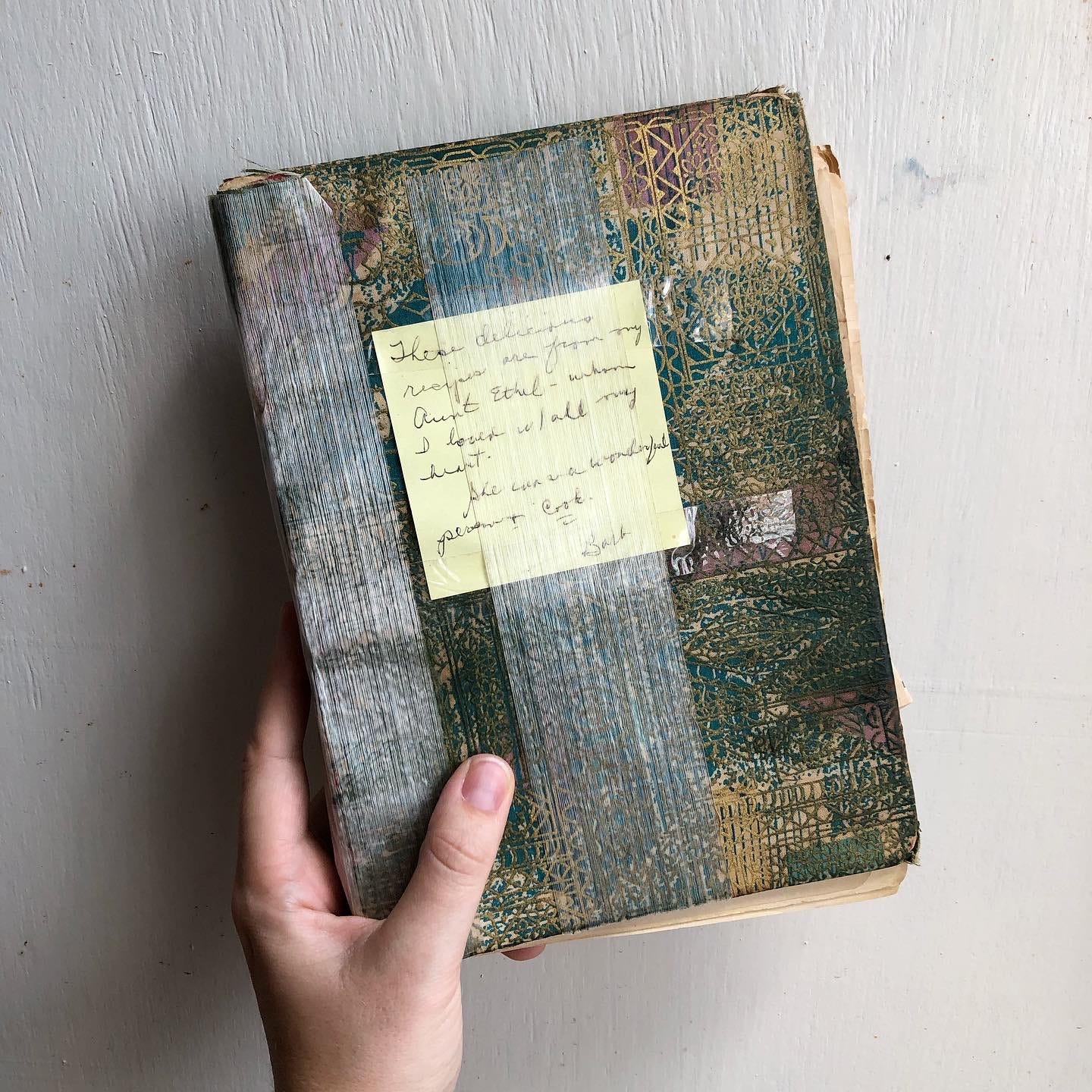
Yes, and no. The objects that come into my studio tend to sit around for a while before I use them. I don’t have any method of cataloging or sorting the objects, but I mentally note objects that come into the studio and catalog them in my mind, making connections in between them and letting ideas fester.
It sometimes happens that a certain object becomes more fascinating or touching to me. I suppose we could call these “special objects.” Once an object becomes special, I tend to hoard it, drawing inspiration and energy from it. If the moment comes that I can use it in my work, I do, but I’m more intentional about where these objects get placed and why. Most examples of special objects have been used in artwork made for family or in prototype artwork made for myself as I am working through ideas.
Do you ever use your own materials?
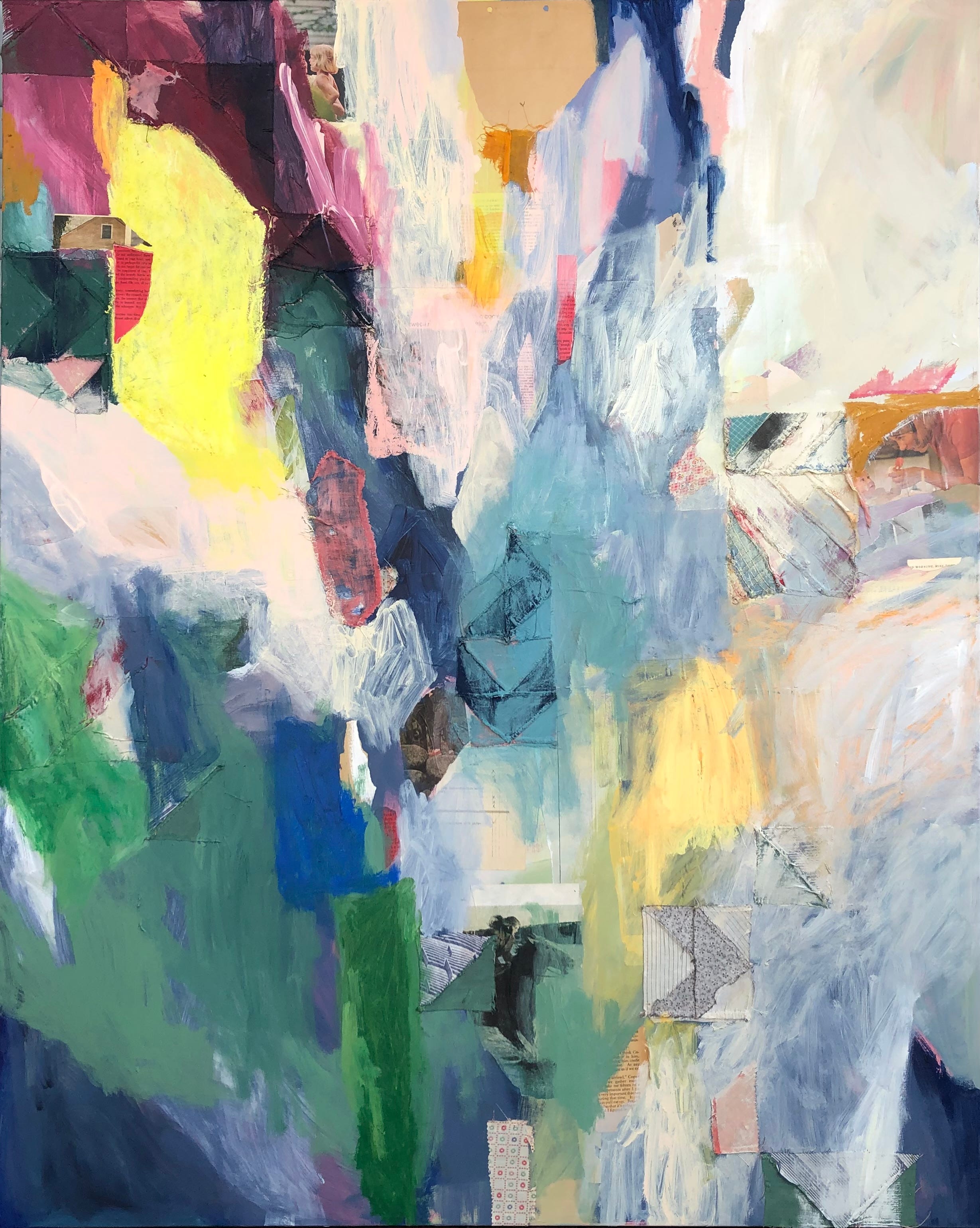
I have, but I don’t often. My CAMHLAB artist residency project (the one where I began collaging large fabric onto canvas), coincided with my parents moving out of my childhood home. I was passed several boxes of special and sentimental objects from my childhood and decided it was time to see how it felt to create a personal piece (I had not typically used personal objects in my work, besides a few small items here and there).
Truthfully, the personal piece was a huge challenge. The process of making it was important to my development in this body of work, but the piece itself was an awkward and unresolved piece of artwork (or so I thought, although I’m sure my perspective was loaded).
The pressure to include certain pieces, the sentimental attachment, the preciousness of the objects, my emotions…they all held me back from objectively considering the artwork as it’s own harmonious thing, a puzzle that I’m solving as I combine objects into a new, whole object.
Why are all the quilts on backwards?
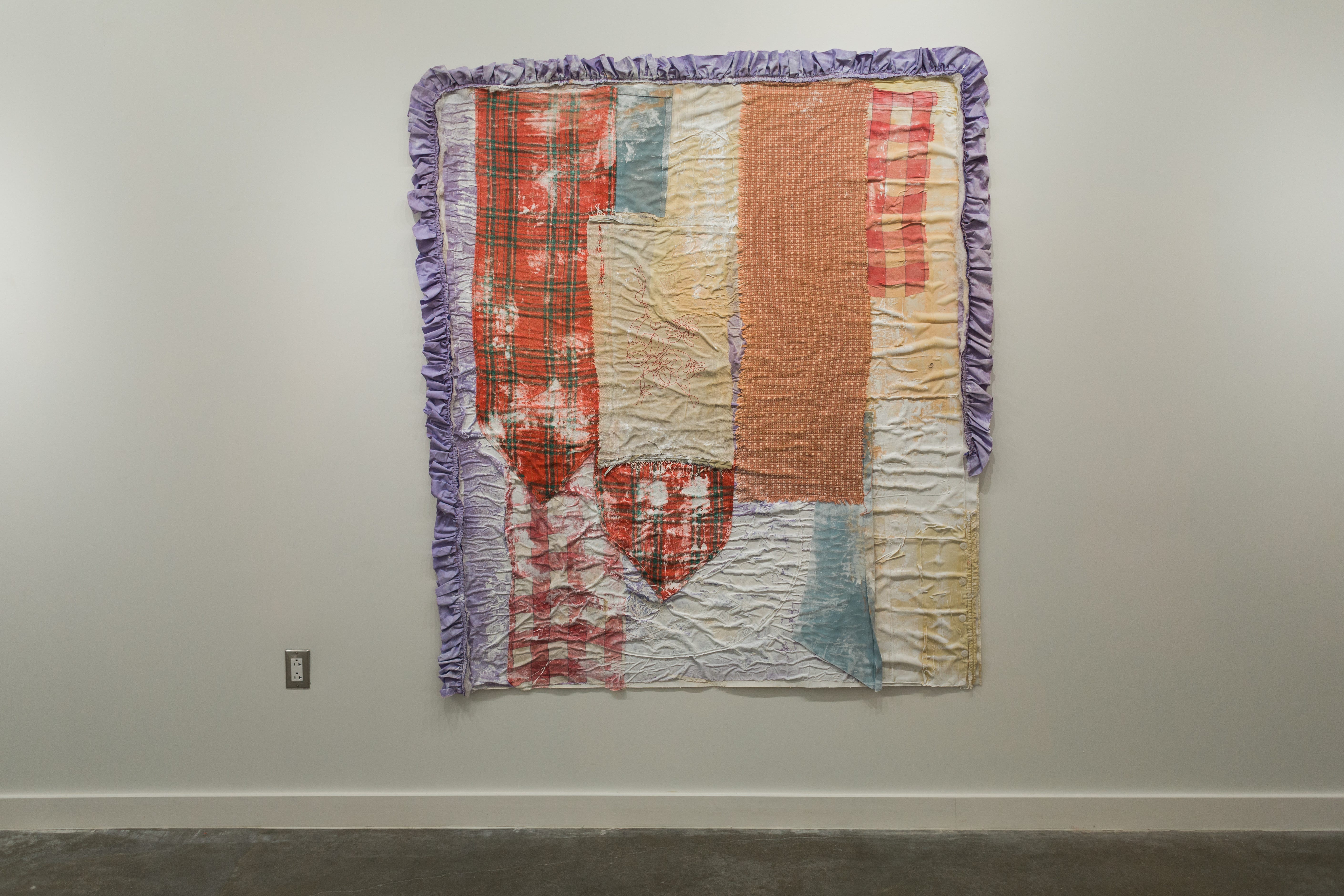
I did that because I visually and conceptually prefer them that way, seeing the seams that are hand stitched with the imperfections and labor of the work on full display. It also has a practical component to how the fabric lays down, making the adhesive work more successfully on the found fabric.
Are the words or objects themselves important or do you think of them as elements like color, just part of the main work?
Most of the objects become like elements of art as I put together the work. I’m not usually focusing on the specific content, like the exact words on the page of text, rather than using it as a piece of texture or change of scale. There are exceptions of course, as with the special objects, where a specific word or image or fabric scrap feels integral to a certain work of art.
Do you do ever work with someone’s sentimental family stuff to make a commission?
I do. There was a time where I was doing this more heavily, but I’ve tapered off as my work has gotten a little weirder. I still take on the occasional commission, especially for a past client or personal friend. If you want to know more about commissions, you can check out this secret page of my website for more information.
How long do they take you?
My process takes months/years because the work is divided into several phases and I generally create work in series.
The seeking phase (collecting, researching) is quiet and often happens while I’m resting, taking time off, or at the tail end of a longer project. I’ll bookmark images, artists, articles, and ideas that catch my interest as a connection to my work. I’ll collect objects that align with the sprouting ideas, I’ll sketch, I’ll make lists.
The planning phase (testing, refining) comes as I begin to create the work. I’ll test my ideas, buy new supplies, problem solve, and determine how I want to move forward with the ideas from my earlier phase. I’m working on a small scale. Here is when I can usually determine if the ideas are any good.
The structure phase (opportunity, support, timeline) comes next (if I’m lucky). This is when I decide how to share the work with the world. Hopefully the planning phase has created enough confidence that I can submit my ideas for exhibitions or grants or other opportunities that can help fund the working phase. I will apply/email/submit/propose, hopeful for an audience for the upcoming body of work.
The working phase comes as I decide to move forward with creating the body of work in the series. This is the phase where people count the hours in answer to the question posed above. I’m typically in this phase 1-3 months. It’s the shortest of the phases, and could never happen without the work of the months/years before.
If needed, after the work is made, I may enter the structure phase again, seeking an audience or support for the work and sharing it more widely, as my mind starts to wander to the next seeking phase.
Thanks, as always, for reading. Replies come directly to me.
—DC
Comments are welcome. As a prompt, I’d like to know, what is a question you’ve been asked about your work (artist or not) and what was your answer?
I find creative process infinitely fascinating, so I really enjoyed both learning what questions visitors asked you and your answers to them. People often ask me about the textiles I'm using, how they are colored (conventional dyes that I overdye with natural dyes), and where they come from (all repurposed domestic or inherited textiles).